



SUPPLEMENT
WHY CLEARWATER?
The many responses to Freedom magazine (published by the Church of Scientology) from local Clearwater residents show that our readers are interested in Clearwater and want to know more about it. Many residents expressed an interest in the colorful history of our city. Thus, Freedom magazine printed a multi-part series on the history of Clearwater, covering the discovery of what became known as Clear Water Harbor by early settlers through World War II. Because of the overwhelmingly popularity of that series, we are reprinting it in full on this web site.
An Interview with Clearwater's Official Photographer

J. Arlos Ogg, the official Clearwater photographer for many decades, is one of the individuals most responsible for preserving the heritage of the city. In this interview, he reminisces about his life and offers insights into the Clearwater of today, including why it is so named.
Four years after Arlos Ogg employed his first unwieldy camera, a large box Brownie, his parents moved to a farm in Brooksville, Florida. Ogg was only 11 at the time, but he had already learned to drive four-horse teams hitched to gangplows, and to build a house from the foundation up.
About the time he was ready for high school, the family moved south 50 miles to Clearwater where Ogg attended Clearwater High School, behind the current site of Ward Elementary. "The population was 2,900 at that time," he recalled, "and I think that included the cats and the dogs." He graduated in 1922 with 28 others from Clearwater, Dunedin and Safety Harbor. Most students arrived for classes by car, as there were no buses then. They met in the courtroom of the Pinellas County Courthouse in Clearwater for the graduation ceremony.
Ogg went on to the University of Florida in Gainesville where in 1926 he earned a degree in chemistry. He then accepted a position as professor of chemistry at the State College in Raleigh, North Carolina. One year shy of his doctorate, the Depression caught up with the college and Ogg's salary was reduced so drastically that he was unable to afford his job. He returned home to Clearwater.
"I sent applications to several outfits and received replies like, 'We were very pleased to receive your application. You are number 175 on our list,'" he explained. "Luckily, I had continued to photograph in my years at the university, taking pictures of the experiments we were performing on tung oil, used as a medium for paint in those days. I had even co-written a paper on darkroom procedure. When I returned home in 1936, I set about learning the trade from a photographer."
50 Years Recording the History of Pinellas

Ogg opened his first studio on Cleveland Street, between Greenwood Street and downtown.
"I was so far out of town," he said, with a glint in his eye, "that the boys wouldn't come to get pictures. If I did four portraits a week I was lucky. I finally moved Ogg Studios downtown to 807 Park Street and the first night I opened, I made 27 pictures. Those four blocks made all the difference."
In the following half century, he took about 60,000 photographs, and not with 36 frames per roll in a self-winding camera. Each of those pictures was taken on the kind of clunky camera that sits on his sofa today, with individual 4- by 5-inch negatives that had to be inserted and then removed one at a time.
There was nothing he would not and did not photograph, from celebrities such as Babe Ruth to the "meanest cat I ever saw," an animal that had won first prize at a celebrated English show. Two of his photographs were displayed at the World's Fair in New York in 1939.
His photographs became even more popular after he married a young Swedish woman, Ruth, who colored his black-and-white pictures with oils. Although this art form all but disappeared with the advent of color photographs, it required great skill to produce results, and Ruth had a rare talent for it. Eastman considered her among the top ten oil colorists in the country.
"Only the Palm Trees Stuck Out Above the Water"

"Things have changed so much," Ogg told Freedom, carefully turning over one after another of his old photographs. "75 years ago, there was only one building on Clearwater Beach, a bathhouse. At that time, you could stand at any point on the beach and throw one stone into the Gulf and another into Clearwater Bay [the intracoastal waterway]. Mandalay Road used to be the shoreline of Clearwater Bay. They filled in the beach to make it wider.
"There was no causeway to Tampa at that time. We would have to go over to Safety Harbor, up by Philippe Park, through Oldsmar and back down to Tampa. You could make it in an hour if you didn't have a flat."
Flats were minor inconveniences compared to the hurricanes Ogg lived through. "I've been in or near nine hurricanes," he said. "We would take all the signs down around town and board up the windows. The hurricane in 1921 completely inundated Clearwater Beach. Only the palm trees stuck out above the water. It tore down all the private docks that extended from Clearwater to the channel. It also widened Hurricane Pass, sending the sand onto the south end of the beach."
The landscape isn't the only thing that has changed. "We were on Garden Avenue when I was in high school. We would always leave our house wide open. We never locked it. If the rain came up, the neighbors would run over and close the windows and the door. Although my neighbor looks after me now, it isn't quite the same, generally speaking."
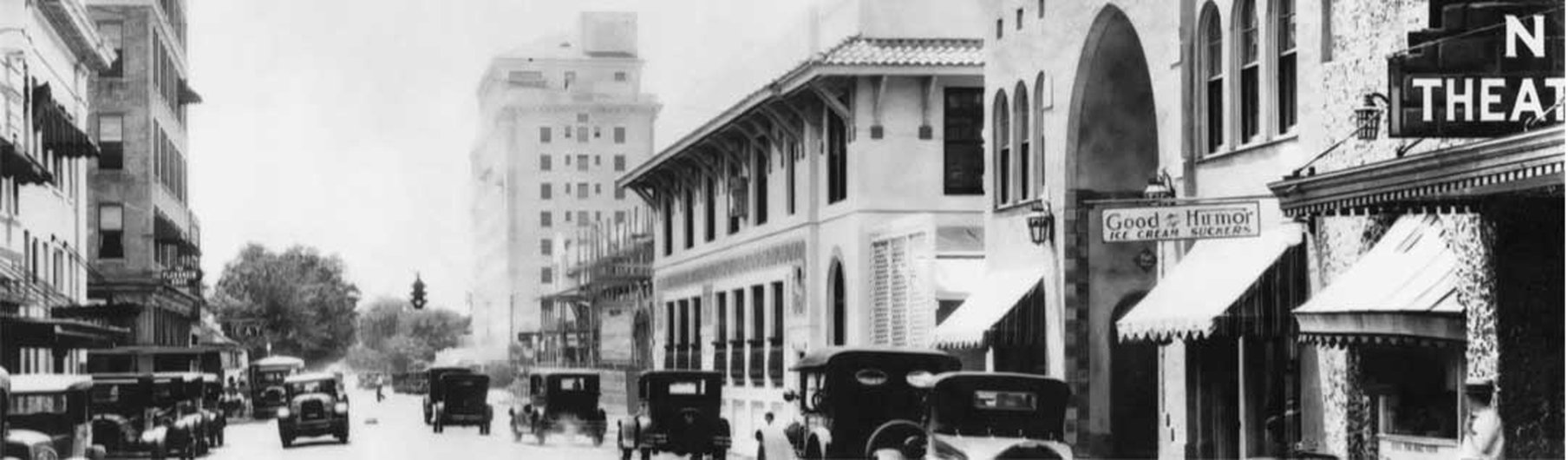
As he moved slowly through his piles of pictures of Clearwater, he paused to describe each. "This is the Five Point Sundry, a store selling sodas and cigars," he commented. "It was on the very edge of town: on Cleveland and Greenwood."
Looking at a photograph of a large brick building standing where today's main library is, he noted, "The original public library was donated by Andrew Carnegie."
"And you see that pharmacy, between the old McCrorys and the Coachman Building?" he asked. "Jack Eckerd took it over. That was the original Eckerd store."
Home Sweet Home

A picture of a small house surrounded by empty fields made him chuckle. "This is my house, the one we are sitting in right now."
Outside, the traffic roared past the tightly packed houses, one block north of Crest Lake Park. "We were going to build a house closer to town when World War II started. The lumber man called and said that all lumber had been frozen and no one could build. So we bought this house instead."
To the east of the house, he explained, lay the largest grapefruit grove in Florida. But there were no trees around the lake itself, so Ruth helped plant the first tree there.
A series of photographs of flower arrangements, colored by Ruth, prompted Ogg to talk of his wife's floral arranging skills. She won many blue ribbons in contests sponsored by the Garden Club, which she helped found.
All of the flowers that she used were grown by the Oggs in their back yard, including magnolias, roses, kumquats, orchids (they had 300 at one time) and kapok blossoms. They also enjoyed the fruits of the banana, papaya and pineapple trees they husbanded.
His art shows history. Here's a picture of mustachioed men-his father and uncles. Here is Ruth's grandmother, a 98-year-old at the time of the photograph, a Swedish princess who had lost her title for marrying the "commoner" she loved. Her uncle perfected the dial telephone. Faces of honest and upright folk pass through Arlos Ogg's hands, people from another age, even though it was less than a century ago.
A wonderfully delicate picture of Ruth and her sister are printed on porcelain, a technique not available for half a century now, but done because the pictures would last more than a lifetime. They look like new.
War
And then, as he described it, the war came. For many, the two world wars were a nightmare. Ogg was one year too young to be conscripted for World War I and one year too old for World War II. But he "did his bit" anyway. When World War II broke out, the Air Corps took over the Biltmore as a training area. The colonel in charge asked Ogg to take a photograph of the first troops arriving.
After the shoot, the colonel called him into his office and said he wanted to fingerprint him. When Ogg asked why, he was told, "As of now, you are the official photographer for the Air Corps, the Marines, the infantry, the Coast Guard and all the military officials in this area. We have checked you out and found that you are probably one man we can fully trust."
The military even conducted meetings in the back room of Ogg Studios, always with Ogg in attendance. The only FBI office in the state at that time was in Miami, and so the military had a phone line installed that ran directly from Ogg's back office to the FBI office. He participated in secret work for the Air Corps in Clearwater and the Marines in Dunedin.
It is sometimes curious which memories stick over the years. Ogg remembers that because the Biltmore was constructed in the 1890s, it had no overhead sprinkler system. So the Air Corps took all the doors off the hinges and placed guards on each floor "to make sure the boys didn't smoke in their rooms."
While the official photographer for the U.S. forces in the area, Ogg also single-handedly provided the half-dozen local papers and as many international news services with photographs from Pinellas and Hillsborough.
He was the first paid photographer for the Clearwater Sun and also served as staff photographer for the Tampa Tribune, the Tampa Times, the St. Petersburg Independent, the St. Petersburg Times, the Clearwater Times, International News Service, Associated Press, United Press and a "bunch of other outfits." It was certainly not an idle time.
And Peace
When the war was over, life took on a more relaxed pace again. During the summer, practically everyone would leave town. They would close the stores right after school, load up their cars and take off in a cloud of dust, touring through every state east of the Mississippi River.
Around that time, he recalled, "Two boys came and started the airfield out here. I knew both of them, so when the city asked me for some aerial shots of Clearwater, I went to the airfield with my camera and a bunch of [film] plates. They agreed to take me up. They had removed all the sides and the bottom from that plane, leaving only a frame and two seats. I strapped in and we took off. I looked to the left, to the right, and between my legs, and all I could see was the ground far below-so we took a bunch of pictures."
Looking back over 93 years of colorful life, Ogg smiled and said, "You name it, I've done it. I was even a Sheriff here for 40 years." It is not surprising therefore, that Arlos is one of the few to have been given the keys to the city of Clearwater in recognition of his many contributions.
And so, why is Clearwater called Clearwater?
In Arlos' words, "Clearwater Bay was eight or 10 feet deep when I arrived here. You could row across the clear-as-crystal waters and see the grass bottom, the fish swimming. Two or three fresh-water springs fed right into the bay. It was the hurricane of 1921 that changed all that. It completely emptied the bay of water. For a short while, the bay looked like a pasture with two streams, which had been the channels, running through it. The grass bottom died, and with it, the clear water."
But the city lives on, with J. Arlos Ogg one of those whose contributions are keeping alive the heritage and character that makes Clearwater what it is.